
Change Everything No 80: When art was politics
On International Women's Day, beware privatisation of the global public sphere

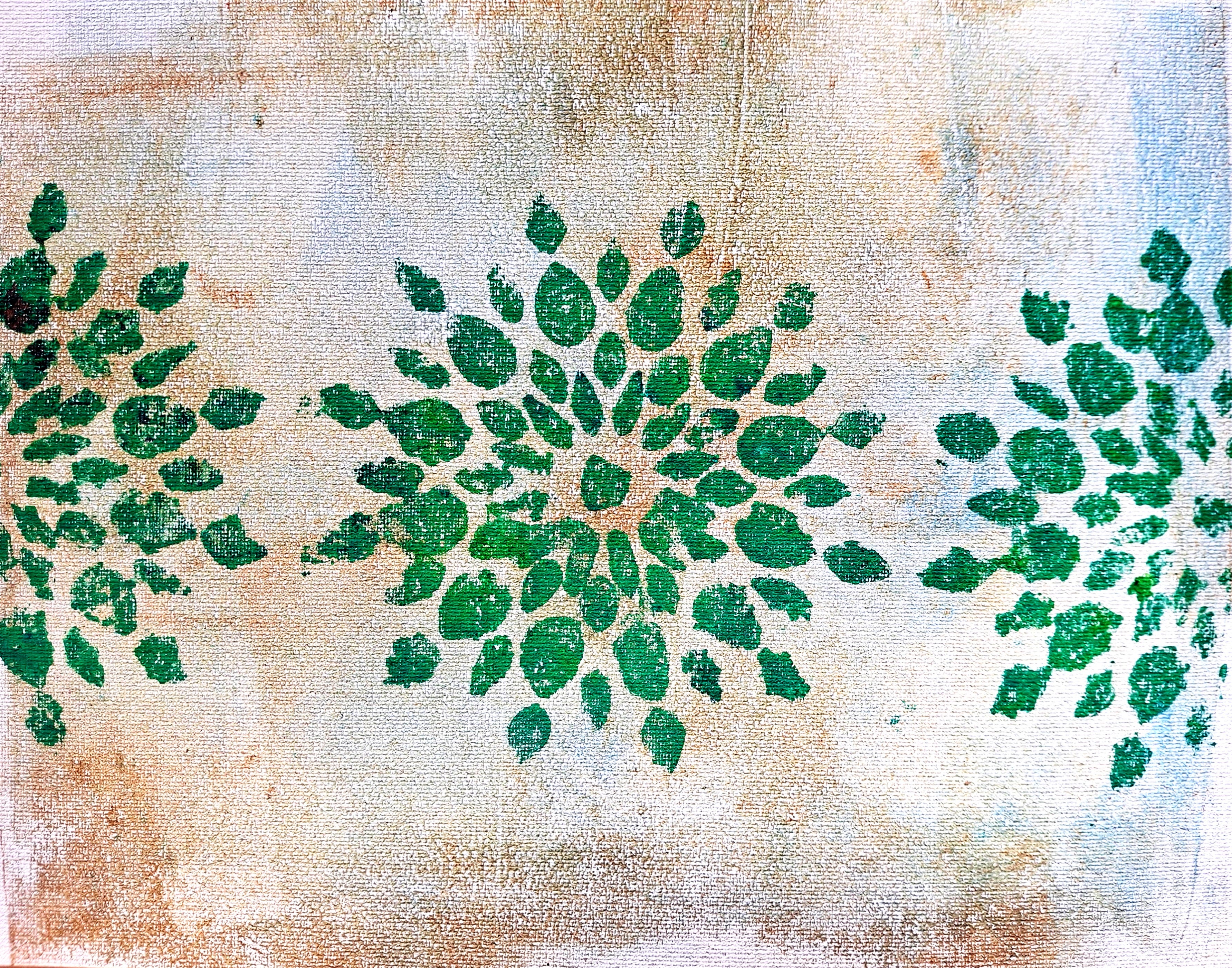
© Natalie Bennett (Gel plate print)
A topical note: Beware privatisation of the international public sphere
I don’t usually mix my daily political work and this newsletter, but particularly on International Women’s Day, when I know there’ll be many events in the coming week marking it, I want to make sure anyone organising or engaging in one knows better than to fall into a trap many did in the House of Lords IWD debate on Friday.
The speech I gave was not the one I’d been planning to, but - as was first pointed out to me by Carmen Smith as we listened together to the minister’s opening speech - it was really important to call out a gross privatisation of the day, the hijacking by corporate interests.
There’s a website called: www.internationalwomensday.com. I’m not going to make it a link, but the .com element of that really should give pause.
It claims that the theme of IWD is “give to gain”, which as I said in the House is “a very neoliberal slogan, one focused on the individual—focused on making a sop to our current system, rather than acknowledging the need for radical change. … It is suggestive of the philosophy infamously promulgated by the cryptocurrency billionaire, Sam Bankman-Fried, who is now of course in jail: so-called effective altruism. That has helped to build a political culture that practically invites the most egregious forms of capture of our public global spaces by the rich. The haves give; the have-nots receive. The have-nots have to avoid challenging the status quo if they are going to get a few crumbs from the table.”
I’m indebted to the Australian website Women’s Agenda for an account of the story behind the dotcom website.
The REAL theme for IWD is “Rights. Justice. Action”, which you can find on the dedicated page on the UN Women website, where it notes correctly that this year’s event“comes at a time when justice systems are under strain. Conflict, repression, and political tensions are weakening the rule of law”. Which is entirely in keeping with the day’s origins in labour rights, women’s activism carried out against great odds.
This seems an appropriate time too to mention the new(ish) podcast Her Voice in the House, on which Laura Dunn speaks to female House of Lords members about their past, present and future work. More about it this week on Politics Home. (And yes, I can offer a sneak preview; I will be appearing on it in due course, probably in April.)
When art was politics
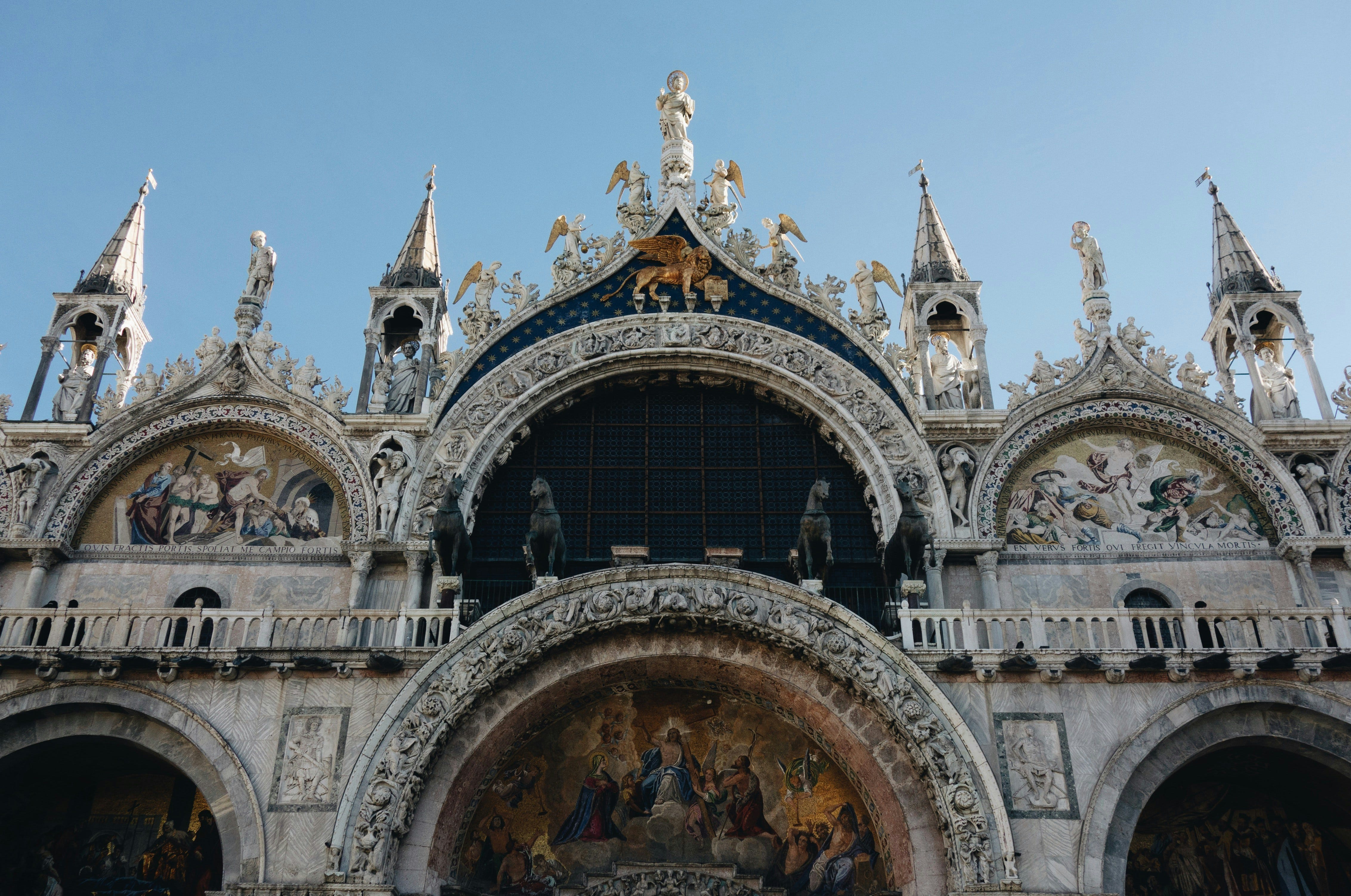
As much a political as religious structure? Photo by Falco Negenman on Unsplash
The concept of “art” as an independent sphere of activity - both its creation and its consumption - a source of personal development, the supplier of a lucrative market, rather than being part of everyday life and personal display, of politics and, more obviously, religion, is a recent one. Some academic sources put its “invention” to the European colonial period, particularly when traders started bringing back masks and other materials from Africa, stripping of them of the organic materials and other decorations and displaying them as sculpture. Others suggest the development of industrial production is key. Oscar Wilde wrote in The Soul of Man Under Socialism: “Now, I have said that the community by means of organisation of machinery will supply the useful things, and that the beautiful things will be made by the individual.”
In his time, there was still a lot of politically conscious art, but so much in recent times has been captured by “the market”, resistance cultures turned into product that we need reminders often like this from Bob and Roberta Smith, which I have on my wall.
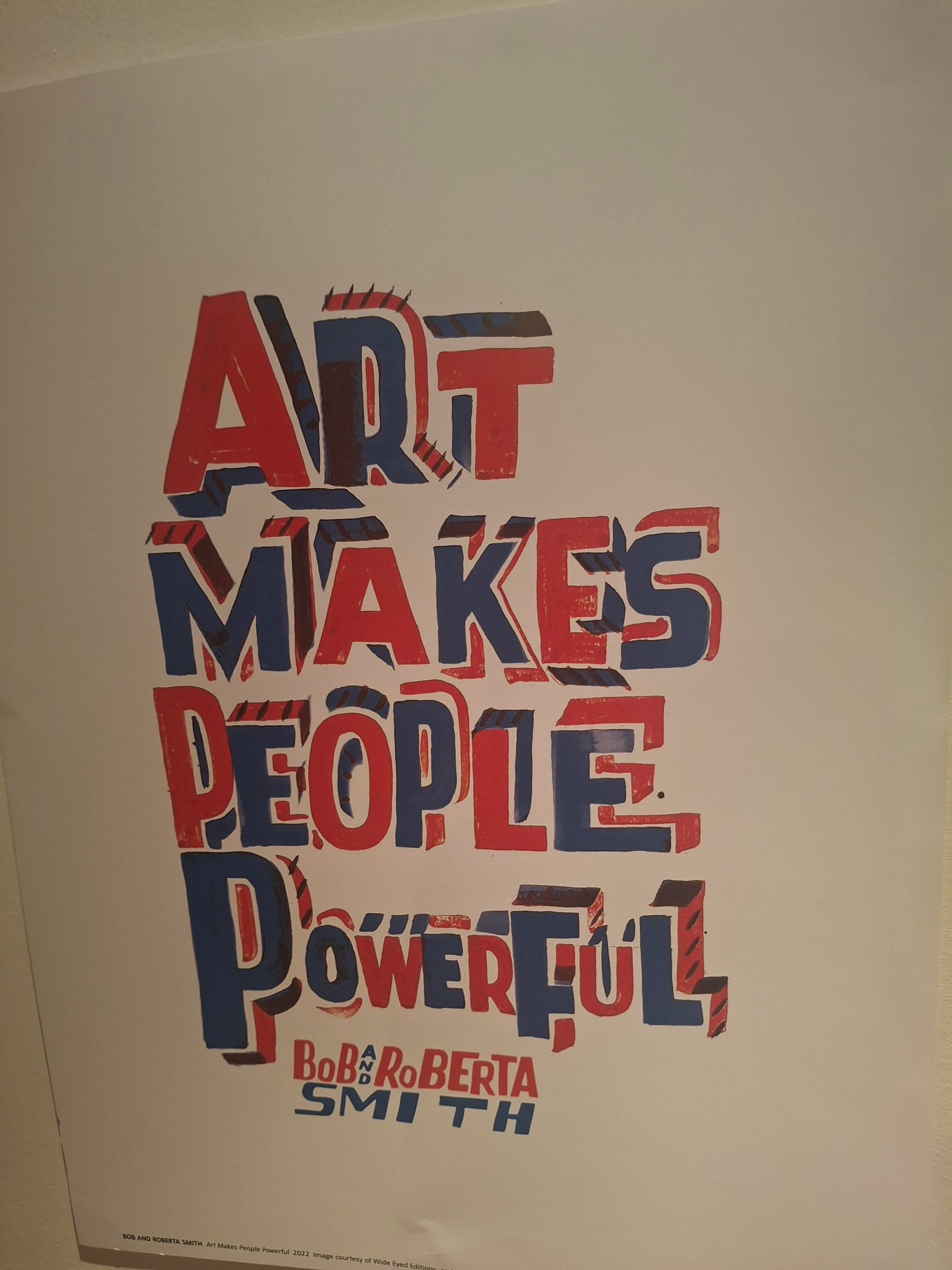
One of the things we have to do today is recapture creative endeavours from the deadening hand of “the market”, and make them part of the everyday experience and activity, something I write about in Change Everything the book. That must be one of few political accounts that has an entire chapter on the importance of restoring artistic endeavours and surroundings in our lives, rather than the junkspace in which we have to spend so much time.
(An aside on the junkspace; it is a term coined by architect Dutch Rem Koolhaas: “We see it in airports, highway systems, shopping centers, office buildings, and apartment blocks. Its materials are concrete, sheetrock, stucco, tape, glue, and staples. Its surfaces are smooth, mirrored and polished, its interiors air‑conditioned, its formal logic one of addition, proliferation, successive transformation, and spatial continuity, opposing it to an architectural tradition of hierarchy, composition, permanence.”)
To put it in practical terms, we need far more art and creativity - particularly public art - in our lives. That would be a huge political change, and a driver of political change.
It takes a real intellectual wrench now, to imagine a time before the invention of the “art market”, when art was politics (and religion was also an important part of the state-building and shaping mix). The intellectual timeshift is done very successfully by Stefania Gerevini. I’ve been reading, and enjoying the sumptious pictures, in her Facing Crisis: Art as Politics in Fourteenth-Century Venice. (The author wrote a short piece for The Conversation on the same topic.)
The history of later medieval Italian city states has not been, I confess, a particular favourite of mine, although one that more than a few novelists have enjoyed exploring (from SD Skykes’ City of Masks to the set-century-later The Glassmaker). So I read this non-fiction account both as informative history, and analysis of the art.
It is focused on a time of massive change and development:
“The protection of Venice’s commercial interests, including its monopoly over the trade of salt, and its access to important fluvial and land routes, generated increasing tensions with the urban centers of northern Italy, leading to clashes with Padua (1304-5), Ferrara (1308-13) and Verona (1336-1339). The latter conflict concluded with Venice’s annexation of the ciry of Treviso (1339), the first noteworthy territorial conquest on the Italian mainland, and with the establishment of an informal protectorate over Padua… a new expansionist phase in Venice’s policy towards terraferma. Paused in the central decades of the trecento, when the war against Genoa, multiple rebellions in the colonies, and the need to confront the Ottomans were of more pressing concern, the enlargement of Venice’s possessions on the mainland resmumed in earnest in the early 15th century.” (pp. 15-6)
This all demanded a comprehensive programme of statebuilding by Doge Andrea Dandolo. On Gerevini’s account, one important aspect of this was the creation of books of public history, the Chronica Brevis, a list of names, dates and facts that could help administrators, and the much more expansive Chronica per extensum descripta.
“It recapitulated the names, responsibilities and honors of its leaders and enumerated and expounded Venice’s interactions and diplomatic relations with a range of ecclestiastical and secular powers across the Mediterranean. Finally, it offered a comprehensive assessment of Venice’s religious history, with specific focus on the holy treasures (relics and saints’ bodies) accumulated by the city’s government over time. .. a powerful means of political certification and stablization and a toolkit of public governance that reminded its readers - the Venetian governing elite and chancery officials - of the origins and constitutional values of their state when taking public decisions and actions in the face of changing problems and environments.” (p. 30)
The thesis is that the art of San Marco was part of the same work. It “did not merely reflect or illustrate the political and institutional realities within which it was created; it contributer to the formation of those realities in the first place.”
There’s gender politics mixed in with the national on the high altar. For the (relatively) humble congregation in the nave, the main image would have been the angel Gabriel and the Virgin apparently suspended (on dark pillars), but for the elite who could approach closely, they could see two small enamelled figures of obvious political import.
“The pala d’oro was refurbished between 1343 and 1345 only months after the financial agreement with Anna of Savoy. Although the two events were not directly connected, the recent diplomatic rapproachment more between Venice and the Byzantine regent to the throne — who had asked for and obtained Venice’s financial support to defend her son’s future ascent to the Imperial throne against rival pretenders — may have inflected contemporary understanding of the altarpiece, which conveniently juxtaposes the portraits of a doge and a Byzantine empress presenting them as equals in the conspicuous absence of any Byzantine male rulers.” (p. 50)
Saints and holy relics, depicted and contained within sumptuous creations, were an important part of the way Venice cemented its growing power, Gerevini says. They didn’t challenge the cult of St Mark, rather coexisted with and supplemented it. “A set of precious relics of the Passion, allegedly translated from Constantinople to Venice in or after 1204, were more vigorously promoted in the 14th century, particularly by Andrea Dandolo.” (p. 105) The chapel of Sant Isodoro (of Chois), “worked visually to persuade viewers of the worthiness of the Eastern martyr and of his real presence in San Marco”.
There’s a lot of success and sumptuousness here, but also a reminder that there was resistance to the oligarchy. Gerevini notes that the list of doges in a dedicatory inscription in the grand structure is incomplete. Therte’s Dandalo (1343-54) and Giovanni Gradenigo elected on April 21,1355. In the gap was Doge Marino Falier.
“Following his failed attempt to overturn the oligarchic government of the city, he was the first and only doge … to be publicly executed, and died on the monumental stairs of the ducal palace… The conspiracy generated huge tumult in Venice and the doge’s violent death became … a powerful reminder of the limits of ducal authority.” (p. 139)
And there was also serious political theory in this mix. Gerevini points to the traslation of Aristotle’s Politics into Latin by William of Moerbeke (at the request of Thomas Aquinas) in around 1260 as a key moment.
“It was no longer necessary to conceptualize temporal power as - exclusively - a remedy against human evil and depravity. Instead, medieval theorists were now able to embrace the possibility that living together in an orderly polity might be ‘altogether natural to mankind,’ as Aquinas put it, and that living in a city 'was ‘living in a perfect community’. … Aristotle had posited the existence of three types of government: monarchy and aristocracy… and the less familiar category of politia, a polity where ‘the body of the people acts in the name of the common good’. This category proved critical to contemporary understanding of the Venetian state, and it offers a useful matrix within which to situate the baptistry mosaic.” (p. 198-9)
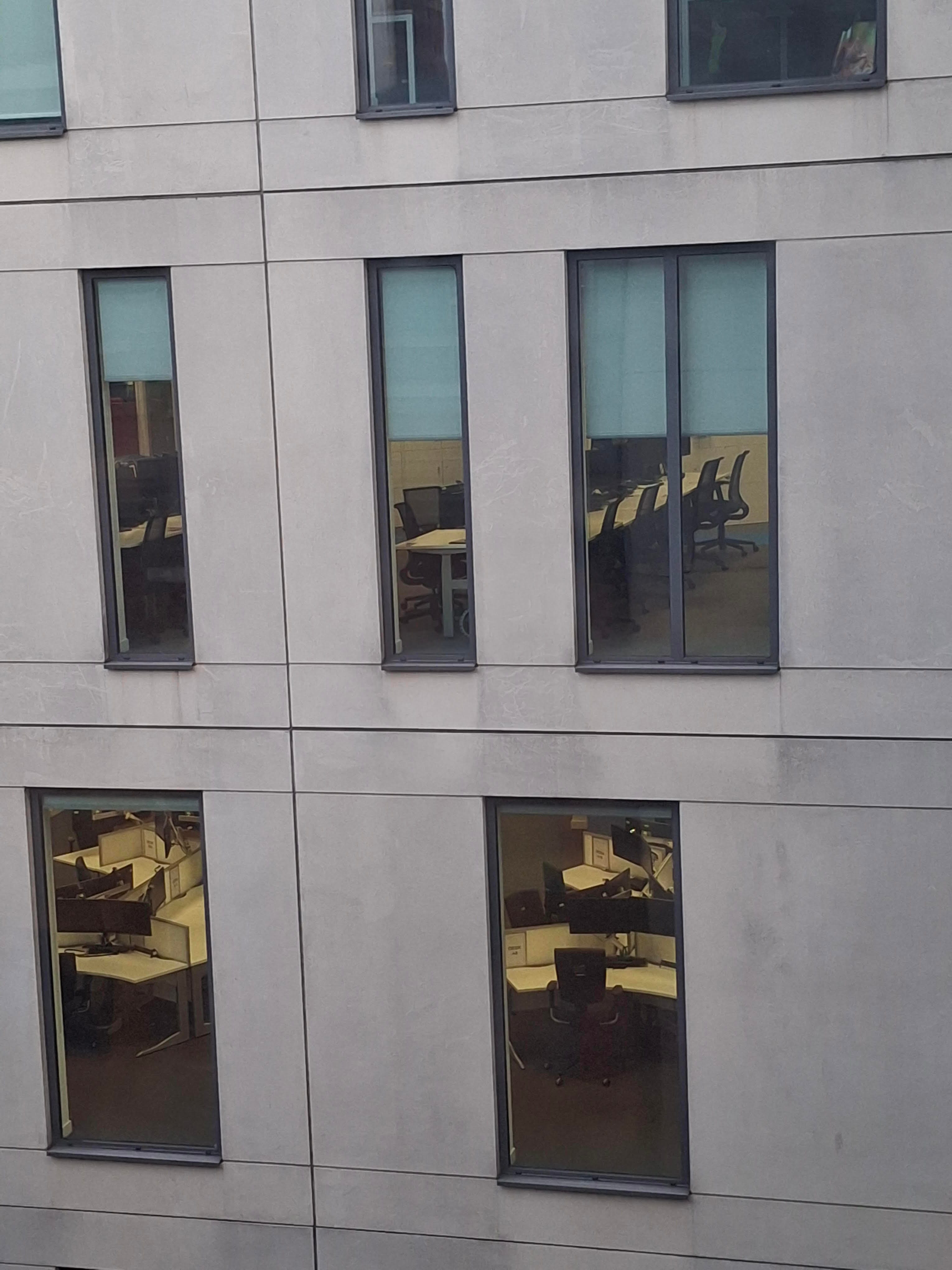
All of this forms a useful reminder that the medieval period is not some stretch of dull misery, suffering and subsistence, rather - like all others - a time of sophistication, flourishing and change. That is the human condition for most of our history. Although you might argue how we’re doing now, creating junkspaces like this that I was considering from a hotel room in Manchester recently.
Almost the end
When, when, when, are researchers going to stop expressing shock at the sophistication of our ancestors, in this case in Europe from 6th to 3rd millennium BCE?
“Each culture had their own complex culinary traditions…. hunter-gatherer fishers were not living on fish alone; they were actively processing and consuming a wide variety of plants.”
They used cooking pots, they had recipes, they liked their food to taste good. Oddly, very like us. Indeed, when we think about more than half of British calories coming from ultraprocessed food-like substances, rather better than us.
What did you think?
You can also find me on Bluesky, Instagram, Facebook, LinkedIn, TikTok and X.
Thank you for sharing a shout out for Her Voice in the House! Looking forward to sharing our interview shortly.