
Change Everything No 79: What changes, and what stays the same?
On the history of palm oil and women in parliament, geopolitical futures and clown fish

© Natalie Bennett (Gel plate print)
Today
I’m not going to write extensively on the Israeli-US attack on Iran, or its retaliation around the Middle East, (that may come) but if you are interested in “what next” for the long-suffering Iranian people, this is a clear-eyed, if not optimistic, analysis (£) about what’s most likely:
“Iran … left with an institutional vacuum, economic and infrastructural devastation, and no meaningful assistance from abroad. Trump could not care less about democracy, with exhibit A being Venezuela. He has no day-after plan for Iran, and most of the U.S. government personnel who might have once formulated such a plan have long since been fired….State failure and collapse into civil war is a more likely outcome than either democracy or a monarchical restoration.”
I did look back to a review I wrote back in 2006, of Iran Awakening, the autobiography of Shirin Ebadi, lawyer and winner of the 2003 Nobel Peace Prize. Her story helps illustrate just how long the US has been disastrously meddling in Iran. Her father was a minister in the government of the democratically elected Prime Minister Mohammad Mossadegh, overturned in a CIA-backed coup in 1953. The US (and UK) then established in power what she describes as “the gilded court of the shah, whose officials cavorted with American starlets at parties soaked in expensive French champagne”. She initially - like many - welcomed the revolution, understandably after the repression and corruption of the Shah, but soon realised what a disaster it would be for Iran’s women. That review doesn’t cover, and I suspect most have forgotten, that the US backed (with billions of dollars, special forces training and intelligence sharing) Saddam Hussein’s attack on Iran in 1980, leading to a war that claimed some 400,00 lives and left the two states at its end in exactly the positions they started.
An admin note
A reader last week asked about where to find the details of the books I’m referring to. What I do is the first time the title is mentioned it will be hyperlinked to the book’s details, usually the publisher’s website.
Picks of the week
Reading
More on the Congo, this time about British-linked exploitation: Lord Leverhulme’s Ghosts: Colonial Exploitation in the Congo, by Jules Marchal (translated by Martin Thom), which covers the exploits of soap magnate William Lever, whose company has morphed now into Unilever, known as something of a philanthropic owner in the UK. But that was not his role in the Congo. When the UK colonial authorities wouldn’t grant him control over already communally owned lands in their territories to scure palm oil supplies (yes, the product has a long and disastrous history continuing to today), he went to the Belgians. It became an empire that totalled 5.5 million hectares, almost twice the surface area of Belgium. (p. 19)
Lever first made contact with Jules Renkin, the Belgian Colonial Minister, towards the end of 1909. With Max Horn of Antwerp, Renkin’s emissary, acting as an intermediary, Lever obtained on behalf of his company, Lever Brothers, through a Convention signed on 21st February 1911, the option to purchase 750,000 hectares of natural palm groves at a knock-down price. He was free to choose them within five “circles” measuring sixty kilometres in radius, around Bumba and Barumbu on the river Congo, Lusanga on the river Kwilu, Basongo on the river Kasai, and Ingende on the river Ruki. (p. 1)
His agent was the Belgian Henri Dekeyser, infamous as “commandant of soldiers who, in Bumba region, had cut off the feet of a chief’s daughter, in order to seize the heavy brass anklets she was wearing”.
Lever (who would become Lord Leverhulme in 1922, needed labourers for the hard work of harvesting the palm nuts, but he was only prepared to pay a pittance. The alternative was obvious: forced labour.
“When in the Congo, Lever was able to ascertain for himself that the wage he was paying for the cutting of clusters was insufficient. Indeed, in a diary entry for Christmas Eve 1912, he noted that the problem of the cutters of palm fruit “has grown as an ominous dark cloud”, and that the people of Lusanga were no longer bringing fruit, after having done so for barely a year. From this Lever did not conclude that it was necessary to reduce the number of clusters to be cut each day. He did not want to devote money to ensuring the fair remuneration of Africans, who, given such circumstances, would have worked quite willingly. Instead, he adopted the method generally used during this period to make Africans work, namely, coercion. In mid-December 1912, prior to Lever’s arrival in the Congo, his agent general had anyway asked the governor-general of the colony to set up a State military post in the vicinity of Lusanga, with patrols travelling the length and breadth of the region.
It took some time to get the full forced labour system set up.
On 8th May 1922, Horn confirmed the good news announced in Moseley’s letter. He wrote that palm-oil production had risen steeply in the month of March, because territorial civil servants, apparently on the governor-general’s orders, had “applied themselves more to encouraging natives to work for the Company”. The governor-general in question was Maurice Lippens, an advocate of forced labour in the Congo—as is plain from his 1922 circulars… In the circular dated January 1922 he particularly deplored the fact that, in the course of his journey across the Congolese provinces, he had been compelled to acknowledge that the authorities were not always lending adequate support to the colonists, traders, agents and directors of the commercial and industrial firms, large or small. He added that all government agents and civil servants should realise that it was their paramount duty to uphold such efforts. (p. 19)
The Second World War brought only an intensification of the exploitation:
The Congo was cut off from Belgium, which was occupied by the Germans. The Belgian government, in exile in London, and Governor-General Ryckmans, in Kinshasa, gradually imposed harsher and harsher demands upon the Africans, in order that they contribute to the defeat of the Germans. On 21st January 1941, when Great Britain was alone in sustaining the struggle against Germany, the Congo concluded an agreement with London concerning the supply of raw materials. Palm oil was at the top of the list, and, as may readily be understood, that suited only too well the biggest oil producer in the country, Huilever, which was of course run by Englishmen. (p. 211)
So far as I’m aware (happy to be corrected) there’s no monument anywhere in the UK about the contribution of these workers to the war effort.
A leaflet from Port Sunlight Trust (PDF) (based in the “model worker” village built in England for the company) accessibly sets out the story. Alternatively, there’s an interesting global account from an architectural historian here, who finds the imprint of palm oil exploitation on the streets of Brussels and traces its modern-day place around the tropics.
As for today, eastern Congo in particular is now under the control of a “military bourgeouis”, with a system that has produced an “equilibrium of violence”, as academic Jason Stearns says in this 2022 podcast.
Listening
The latest episode of the Hansard Society Parliament Matters podcast is and interview with historian Nan Sloane, who’s just published a biography of Margaret Bondfield. Who? you’re very likely to say. In fact I did.
I know about Nancy Astor, of course, the first woman to take her seat in Westminster, and Constance Markievicz, first woman to be elected (but standing for Sinn Fein she did not take her seat), and Ellen Wilkinson, Labour secretary of education from 1945, but Bondfield just wasn’t on my radar.
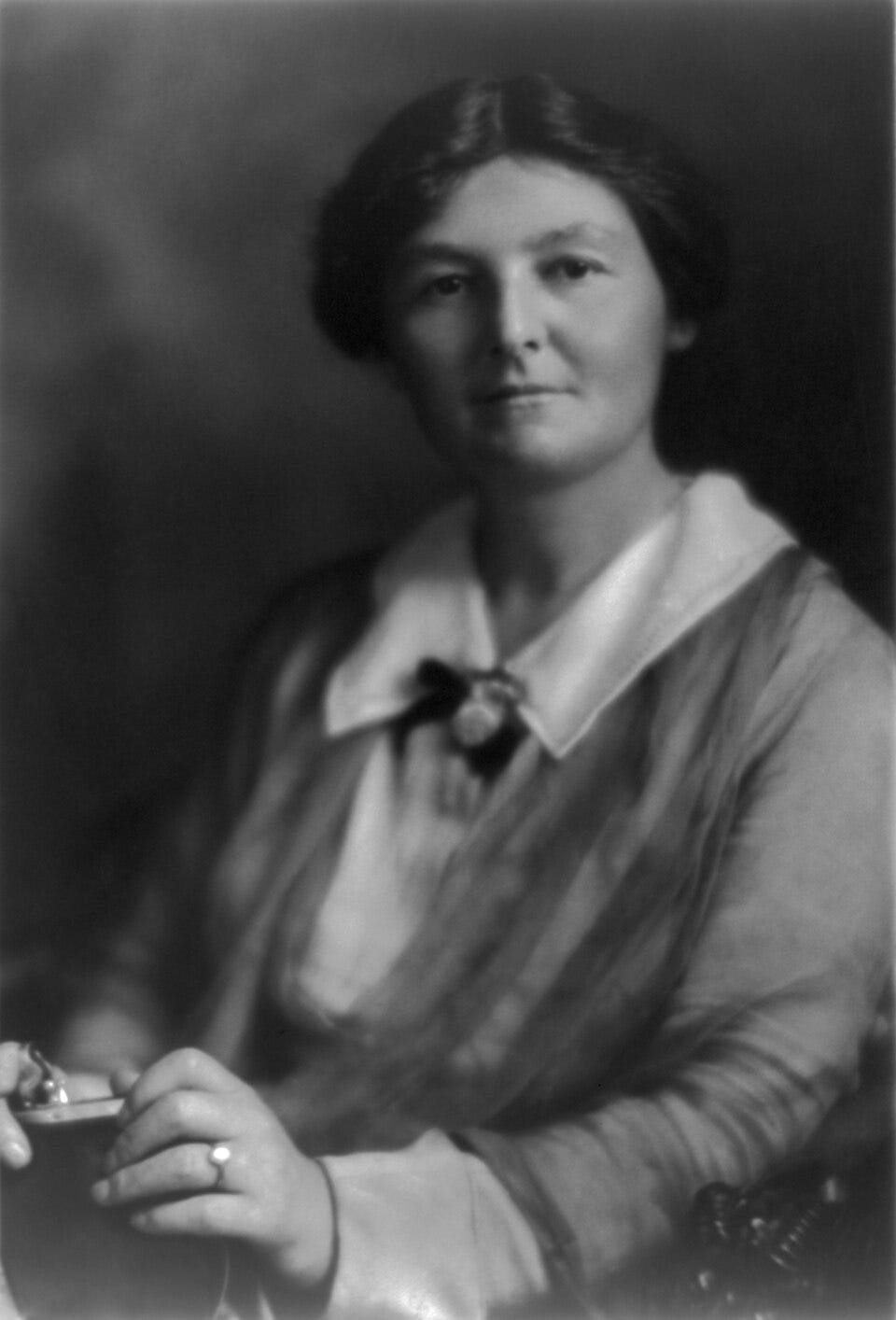

Sloane provides some understandable reasons why she’s largely been ignored - a shortlived government (dealing with extremely difficult circumstances), the fact that she was never a suffragette or suffragist (she was focused on the lack of universal suffrage for men as well), and she was pushed by the circumstance of the time into making some deeply unpopular decisions. (When Barbara Castle was made Minister in the department by Harold Wilson in 1968, she insisted that the name be changed to Department of Employment, so as not to be associated with Blomfield.) And having lost her seat in 1931 Blomfield never returned to parliament.
Also the first woman to be elected to the General Council of the TUC, in 1918, she operated for much of her life in otherwise all-male environment, and on Sloane’s account in that position was forced to fit into male cultures, rather than having any opportunity to really carve a different path. She was also very much a product of her generation, seeking to professionalise paid domestic work for women and girls, rather than seeing the attraction of escaping such an inevitably restrictive work environment. She was also intensely private about her personal life, unsurprisingly since she was - Sloane concludes - almost certainly in several lesbian relationships over her life (which Sloane explains would have been seen at the time - while not illegal - as a sign of having never properly matured, and thus deadly to her public standing).
But it was a fascinating life, from near-destitution in her childhood in rural Chard, to refusing, after one year of practice at the age of 14, to be pushed into teaching, the path to security her older sister had followed and the obvious one then for a smart poor girl, into shop work, and then unions.
Sloane offers a cautionary tale about getting law right: acknowledging the damage done to shopworkers bodies by 12 hours of standing, the parliament decreed there must be chairs in shops, one for each three workers. The chairs were duly provided, but then the employers decreed that they could only be used by customers….
This book definitely going on my to-read list, but whether or not you go that far, the podcast is definitely worth a listen.
Thinking
A short book by the Finnish president Alexander Stubb, The Triangle of Power: Rebalancing of the New World Order, beckoned me from the library “new books” shelf. A rightwing president, but still, I thought it worth a read. It’s Finland after all.
But while some of the general platitudes about countries working together and trying to maintain the rule of law was fine as far as it went, it was this passage that left me gasping. (And had it not been a library book might have been sent it spinning into the wall in disgust.)
“The technological revolution is changing science. Over centuries science has cut the risk of humankind’s two biggest killers, disease and famine, and helped us live healthier and longer lives. Yet humans have still been ‘subject to the same physical forces, chemical reactions and natural-selection processes that govern all living beings’, according to Yuval Harari. Not anymore. Humans are transcending biological limits. Bioengineering, bioinformativs, and genetic modification are challenging the laws of nature.” (p. 97)
Really, did this man not NOTICE the Covid pandemic? Has he ever heard of antimicrobial resistance? Has he read any of the multiple reports warning of the climate emergency’s threat to food security? Could his hubris be any more stuck in some 20th-century pulp science fiction novel?
You can in the writing see Stubb’s thinking has evolved since the 1990s in that he appreciates that not every state is going to transform into a liberal democracy, that’s why he calls for a reasonable model of “values-based realism”, which he defines as “a set of universal balues based on freedom, fundamental rights, and international rules, which take into account the realities of global diversity, culture, and history of the nation states, regions, and continents that make up the global order of international relations”…. stay true to your values but understand that the world’s problems will not be solved wiith the like-minded countries alone.” (p. 27)
Looking back to being a university student in 1990, he notes: “in my idealism, I fail to understand that the West’s ideological victory if going without global celebration. Many formerly colonial countries see it not as a liberation but as an extension of a past they hoped to leave behind.” (p. 33) He adds:
“Globally… the rules of critical institutions such as the International Monetary Fund and World Trade Organisation did not change. The UN reacted to events, but its power structure remained pretty much the same- only now without a counterweight to the preeminent power of the US and its Western allies. The nations that had been sidelined remained sidelined.” (p. 37)
He even manages to grasp, quoting a UK Brexiteer, that not everyone in “the West” has benefitted from the sunny uplands of growth that he applauds.
But he’s still stuck in the 1990s in saying like-minded countries, “the West”, include the United States of America. And okay, no doubt the text was finalised before Venezuela and this weekend’s events. But still, he’s very like Sir Keir Starmer in keeping his head in the sand with comments such as “revived unity could prove a crucial asset amid the present disorder, and we should strive to sustain it despite differences with the new administration in Washington”. (p. 56)
There’s a lot of unlearning to be done in so many quarters for people who formed their views in the last century.
Researching

Photo by David Clode on Unsplash
Fascinating research into aptly-named clownfish, finds that their social environment can alter their appearance - no not new “clothing”, but their actual bodies.
For tomato anemonefish, usually only one breeding pair can occupy a particular host anemone, with younger fish taking a subordinate role in the social structure. “We’ve previously shown that anemonefish count bars to recognize each other. So, we know that bars, the white vertical stripes characteristic of clownfish, are essential in communication.”
It had been thought that they’d keep a juvenile appearance when sharing an anenome with older fish, but it seems they develop faster so they are clearly at home, and can’t be displaced by other young rivals. Conversely, if they secure an anenome of their own, they keep their juvenile appearance, so if a bigger adult turns up, they have a better chance of remaining, if in a subordinate position.
What’s very clear is that there’s a lot more going on than their genome determining their phenotype, or even simple environmental factors influencing it. Social circumstances are key.
Almost the end
Love it! If I played computer games instead of writing newsletters, this would be one: Relooted, described as “Africanfuturist”, was created by a team from 10 African countries, and and involves a female hero recovering looted African treasure from Europe and the United States and returning them first to the Museum of Black Civilisations in Dakar, before they are to be returned to their places of Origin.
What did you think?
You can also find me on Bluesky, Instagram, Facebook, LinkedIn, TikTok and X.
Thanks Georgina for the kind words, and it is a fascinating autobiography. And thanks too on Gorton and Denton. For international readers who may not get the reference, the first-ever Green Party parliamentary by-election win: https://theconversation.com/victory-in-gorton-and-denton-is-historic-for-the-greens-and-cataclysmic-for-britains-two-party-politics-277001
Another very informative post as events in and around Iran are so destructive. I’ve always had an interest in Iran and last year read Shirin Ebadi’s book. A fascinating autobiography and her determination and pride in her Iranian culture. Too many women in prison too and the terrible executions. I also enjoyed Persepolis just recently and surprised I hadn’t discovered this earlier. It was on a list of banned books - USA. Too violent. Eric Carle on the list too for Draw a Star. Delightful book for imagination and drawing but banned as two naked people drawn! So glad Green values are gaining ground now and hopefully some sense can be made of the all this. I admire your ability to write such interesting posts and show up for us all in Gorton and Denton. A great effort.