
Change Everything No 77: Foundations of today in modern history, in antiquity and biology
'White do-gooders', the shared spirits of the past, chinful wonders and strange deep-sea sight

© Natalie Bennett (Gel plate print)
Picks of the week
Reading
Continuing my exploration of the history of the Congo, I’ve been reading A ‘Crisis of Whiteness’ in the ‘Heart of Darkness’: Racism and the Congo Reform Movement, by Felix Losing, a fascinating (if quite academic) exploration of something of which I was previously unaware, the British and American Congo Reform Movement, which from around 1890 to 1913 campaigned against the atrocities of the colony controlled by the Belgian king Leopold II that has been described as providing the early foundations for later human rights movements.
But troubling foundations they are, for as Losing makes very clear, they are deeply racist, built as much on concern about “darkest Africa” supposedly perverting white superiority, as about defending vulnerable people. White saviours are us: “The Congo reform movement created a potent humanitarian narrative based on a vivid, three-cornered metaphor, in which ‘civilised and white saviours’ rescued ‘helpless Congolese victims’ from their ‘savage African perpetrators’.” (p. 345) More, there was inbuilt an acceptance of colonialism, of exploitation and domination: “They maintained, against all evidence, that the Congo Scandal was exceptional in Europe’s and America’s on-going subjugation of the globe, distinguished not in degree but kind from neighbouring imperial formations.” (p. 340)
The racist nature of Conrad’s The Heart of Darkness is now widely accepted (an interesting reclamation has been made by one modern poet), but that came very late in the day, after Nigerian writer Chinua Achebe’s “seminal” speech at the University of Michigan in 1975 explaining its “image of Africa as ‘the other world’”. Losing writes:
Undeniably, Conrad described the Congo as a prehistoric and natural space of mythical darkness where “vegetation rioted on the earth and the big trees were kings”. The absence of human interference and signs of cultivation within the abundant and royal ruling forests that Conrad described serve as the backdrop for the dehumanisation of the Congolese characters in the novel. The occasional “roll of drums” and “burst of yells” proved that humans breathed in this ‘other world’; however, their existence remained a “black and incomprehensible frenzy” for Conrad and his readers. Like the “cannibals” working on his steamer, the Africans on the riverbanks were almost speechless, simply howling, leaping and stamping, and they remain phantom- or ghost-like characters. The “wild and passionate uproar” of lusts that Marlow projects onto their dances and screams signifies that both the forests and inner human nature in the Congo remain uncontrolled and unmastered. (p. 12)
Hannah Arendt also comes in for rightful extremely strong critique, for her theory of racism, also apparently “caused” by Africa and Africans. “Race-thinking-before-racism” she regards as humanist and largely harmless. Race-thinking,Arendt concluded, might have even disappeared “if the ‘scramble for Africa’ and the new era of imperialism had not exposed Western humanity to new and shocking experiences”.
“This shocking experience, Arendt outrageously maintains, was the discovery of the revolting ‘savagery’ of African ‘natural men’. In the middle of her chapter on imperialism and her reflections on the emergence of racism, Arendt deployed a vision of the ‘the Phantom World of the Dark Continent’ at the eve of its European conquest that is so full of dehumanising stereotypes that one is inevitably baffled to find such distortions within an otherwise highly sophisticated and critical study.” (p. 15)
Where did this come from, Losing asks? Not any direct evidence at all, but via Heart of Darkness, “whose racist imagery she uncritically accepts as displaying actual facts about pre-colonial Africa.”
The history and dangers of stadial theories of history are beautifully explained:
Initially developed in the course of westward colonial expansion starting in the 15th century and based on memories of Europe’s own “domestic” ‘wild men’, the concept of the “extra-European” ‘savage’ was long exclusively applied to Native Americans. It was only in the course of the 17th and 18th centuries that it slowly transferred to Africa. The antagonism between ‘civilised’ and ‘savages’ is as “complex” as it is “ambivalent”. In its temporal dimension, it asserts an asynchronous status of historical time and cultural development, which declares the latter to be the “contemporary ancestors” of the former. “In the beginning all the World was America”, John Locke famously wrote in 1728, claiming that America’s original inhabitants still dwelled in a ‘state of nature’ that was not simply ‘backward’ but ‘pre-history’. (p. 33)
There’s a fascinating appearance by Charles Henry Pearson, a figure from Australian history that might be taken as a classic example of the failed younger son heading off to the colonies, for a life where he never quite achieved the acclaim and advancement he thought his due, despite having been president of the Oxford Union. I pity the girls of the Presbyterian Ladies College in Melbourne, where he was founding head. (Someone should really rewrite his distinctly Victorian-sounding Wikipedia entry.)
“In his National Life and Character, first published in 1893, Pearson challenged the general assumption, as he called it, that “higher races of men” or those of the “highest forms of civilization, are everywhere triumphing over the lower”. Instead, the high mortality of Europeans in tropical and semi-tropical climates and the worrying fact that “the lower races of men increase faster than the higher” pointed for him to the “unchangeable limits” of white and European superiority.” (p. 39)
This is the “white crisis” of the book’s title (and a contributor to the thinking behind the White Australia policy), and has many modern echoes in much of the White Supremicist writing of today. Exposure to the so-called primitive or even just different must be contaminating in this account. “Fear circled around what was interpreted as worrying signs of ‘racial’ and cultural decline, political and economic vulnerability, and the social and political fragmentation of ‘whiteness’, ‘civilisation’ or the European ‘family of nations’.” (p. 39)
“Pioneering (fictional) contributions to the reform debate explore the ‘dangerously’ close affinity between the ‘dark and anachronistic’ Congolese ‘wilderness’ and the ‘dark and anachronistic’ lusts and instincts slumbering in their European protagonists. The stories cumulate in the horrifying realisation of how easily the thin veneer of ‘civilised’ behaviour can erode. The claim that the Free State had ‘gone native’, as the ivory trader Kurtz did in Heart of Darkness, was a reoccurring indictment in the reform discourse.” (p. 344)
In another interesting parallel to the present day, there was fear of “the murderous potential of capitalism and technology”.
“The reformers criticised the suppression of free trade through monopoly capitalism and the conflation of political power with that of money as a deterioration of political and economic culture. Some denounced with particular vehemence the influence of a destructive and ‘vampiric’ financial capitalism and the ‘debauchery’ and ‘moneygrubbing’ of Léopold and thus revealed the in fluence of a regressive anti-capitalism thriving, for instance, in contemporary antisemitic milieus.” (p. 345)
It is not that history repeats, but it often seems to rhyme, when you compare the late 19th and early 20th-century racist discourses to those of today.
Listening
On the Lesche podcast, Michael Satlow, the author of a new book An Enchanted World: The Shared Religious Landscape of Late Antiquity, sets out the diverse world of what we would now call religion as Christianity and rabbanical Judaism were just starting to be codified and solidified (covering c. 200-600AD).
This is a reminder that in this world, filled with gods, angels, demons, and divine presence, not upsetting one of them was a daily preoccupation. And while the discussion does not go in this direction, I can well see how this might be studied in environmental history. If you think a spirit, or a nymph, or a demon, live in an old tree, you might think twice before cutting it down. (Anyone know any books exploring this in this period?)
As Satlow writes in the book’s introduction:
“To get by in the world required being on good terms with the right supernatural beings and able to ward off the bad ones. Being on good terms, in turn, required constant attention. It was unthinkable to go through an ordinary day without cultivating these relationships, whether in short prayers or invocations, the use of amulets, or offerings and sacrifices. … everyday life would grind to a halt without such interactions.”
We have mostly studied religion through the foundational texts, written by men struggling to put down unchanging rules in black and white. Generally modern writers have dismissed the amulets, inscriptions - the recorded hopes and fears of humans seeking their way in a tough world - as “folk religion”, but this of course is the actual lived experience of the time. Far more real than any early monk seeking to create a normative framework for society.
“While bishops, rabbis and Roman priests were creating and enforcing identities and their boundaries, many historians today believe that they had very limited reach and influence…. I find ‘magic’ and ‘superstition to be mostly unhelpful categories. Terms like this can be found in Hebrew, Greek, and Latin, where they are used almost exclusively to denigrate tarfeted practices. There is little consistency in how such labelling was used, and it is clear that many of the practices that an elite group might label as magic were considered by most to be simply a part of the normal toolkit for communications with invisible beings.”
Ethnic identities were just as fluid and contextual as today.
“For example, when a Jew sometime between the third and fifth centuries (or those who commissioned the epitaph) proudly declares on his gravestone in Beit Shearim, a Jewish cemetery in Galilee, ‘Isaac, son of Sassos, from Arabia,’ in Greek, followed by the month in Hebrew, and then his profession, ‘perfume dealer,’ again in Greek, what is he really trying to convey? Although he never says that he is ‘Jewish,’ based on his name, the location of the grave, and the use of Hebrew, we would clearly consider him so. … Why though, is he explicitly marked as ‘Arabian,’ which in addition to being perhaps an objective marker of his place of origin, would also have brought a different set of expectations?”
And that lack of division, the shared reality, is, Satlow rightly suggests also very useful in the political world of today.
“The traditional stories that emphasize difference are not only incomplete; they have also proved dangerous. They constantly remind us of difference and division and encourage use to separate ourselves from the often evil ‘other’.
What makes all this further interesting is it is rather like the religious landscape of today. Satlow speaks of arriving in the late antique marketplace and seeing a lineup of dream interpreters, all making different claims for the foundations of their “expertise”, some using religious texts or links, others perhaps relying on word of mouth, a good patter or even exotic clothing. Which is pretty well reflects what similar “influencers” are doing on TikTok today.
Thinking
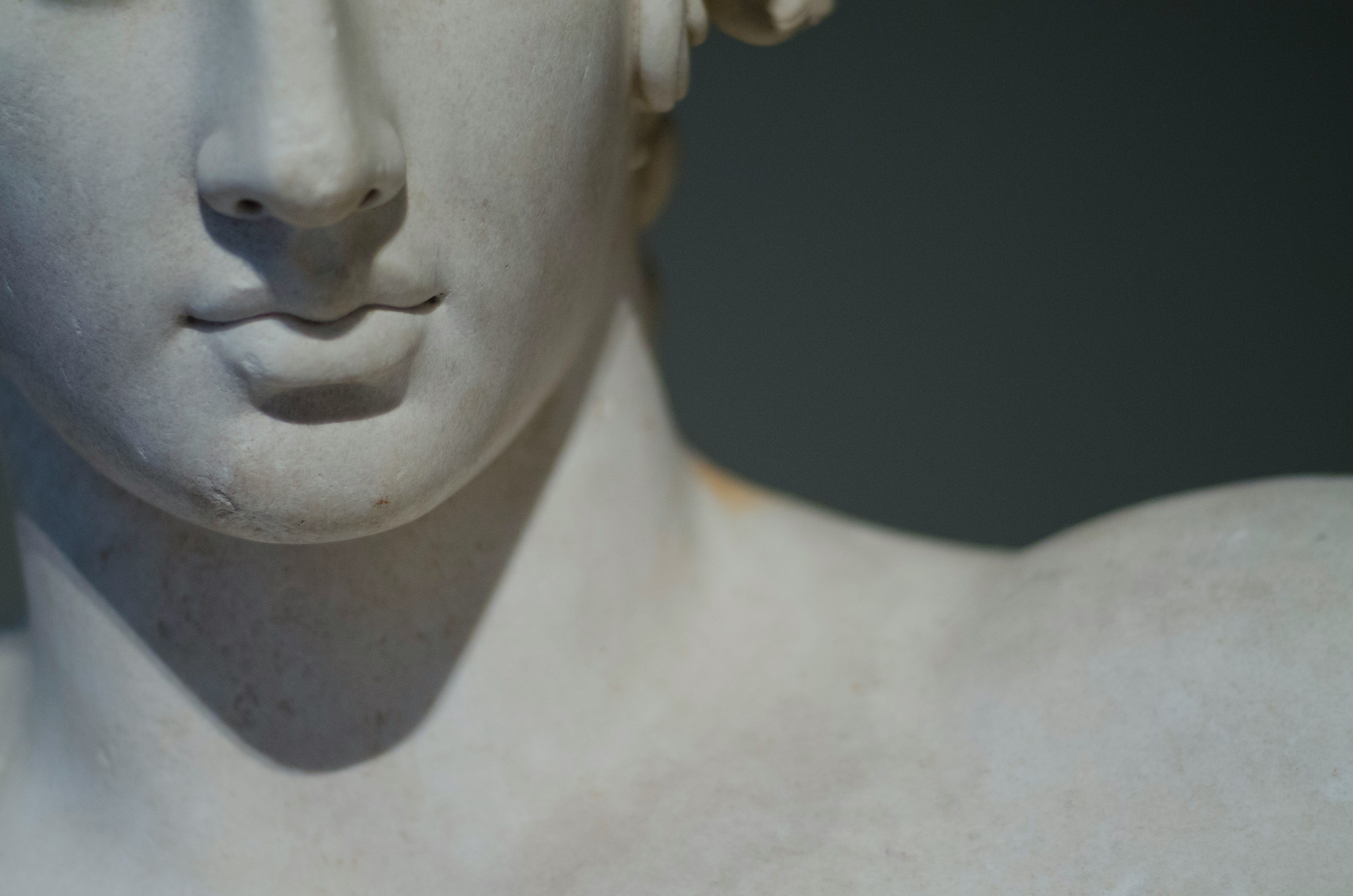
No other animal has a chin. So why do human animals? It is one of those questions that we’ve been wondering about for millennia, as the paleoanthropologist John Hawks sets out. In his comprehensive exploration of the range of explanations that our species has come up with, he ranges from Pliny the Elder’s noting of the peculiarity, to multiple Victorian efforts to use it to explain supposedly unique human speech.
So we get to Theodore Roosevelt being his typically unpleasant self about Homo heidelbergensis as “the Other”:
“He was a chinless being, whose jaw was still so primitive that it must have made his speech imperfect; and he was so much lower than any existing savage as to be at least specifically distinct—that is, he can be called ‘human’ only if the word is used with a certain largeness.”
Of course, the suggestion that sexual selection might be important also featured in 20th-century discussions: the classic chisel-jawed action hero being the exemplar. Except what about beards covering it all up?
Actually, as is so often the case, it turns out humans aren’t so special after all: some Neanderthals have something approaching a chin. As do other Homo species.
But there is now a reasonable sounding scientific explanation, and its got to do with survival in the womb.
I won’t give it away here; do go and read Hawks’ informative piece, and check out the rest of his blog. When new paleoanthropology news gets splashed across mainstream media, often with overblown claims, it is where I always go to get a sensible, considered, expert view.
Researching
Some research you look at and think, whow, that must have been so difficult just to get your samples and work with them. That’s certainly the case with a study of the eyes of larvae of deep sea fish living in the “twilight zone”, roughly 50–200 meters deep, where many develop before descending into the dark depths when adult. As the researchers say:
While these animals are generally thought of as monsters of the deep, in reality, most reach only about the size of a thumb—even when fully grown. They are also very fragile and difficult to get.
The world they live in is ideal neither for “rod” cells in the eye, generally thought to be good in the dark and for sensing motion, nor for cones, providing precision and colour vision. The “rule” has been long taught that in vertebrate retinas, there’s a pattern, cones form first, then rods. But not in these beasties…
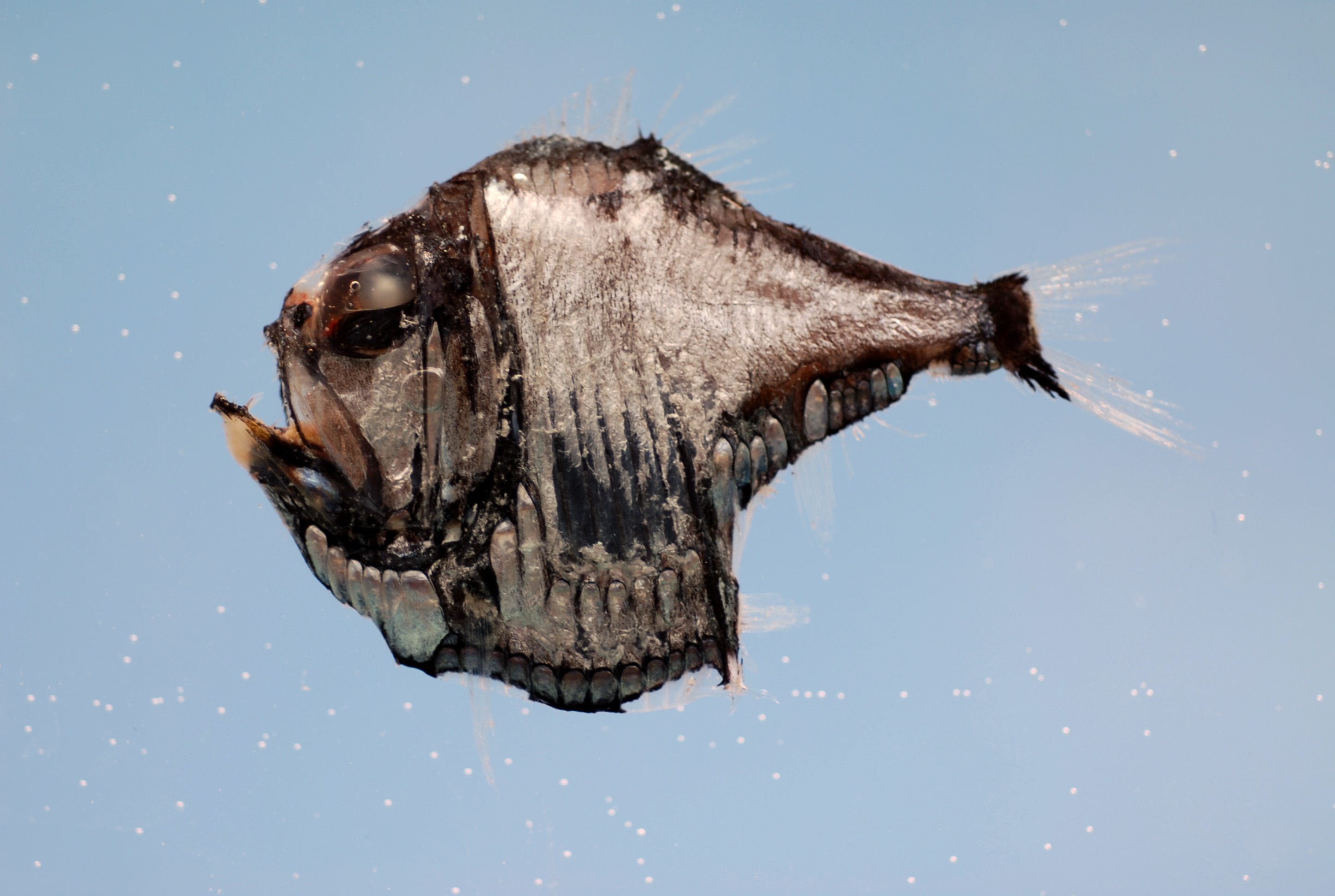
Strange sight in a hatchetfish. Source
The cells they are using early on look like rods but use the molecular machinery of cones, making them rod-like cones. In some of the species we studied, these hybrid cells were a temporary solution, replaced by “normal” rods as the fish grew and migrated into deeper, darker waters. However, in the hatchetfish, which spends its whole life in twilight, the adults keep their rod-like cone cells throughout life, essentially building their entire visual system around this extra type of cell… it represents a fundamentally different developmental pathway for vertebrate vision.
Which provides one more reason to say NO to deep sea mining: we know so little about one of the last relatively untouched spaces on this planet. And also…
For more than a century, biology textbooks have taught that vertebrate vision is built from two clearly defined cell types. Our findings show these tidy categories are much more blurred.
Something more to unlearn.
Biology is never simple and binary, but messy and complicated. It is nothing at all like physics.
Almost the end
Usually this is a fun bit, but got to tie a tragic, and tragically unsurprising, news item from this month from the Congo to the first item in this post: a mine collapse in the DRC has killed more than 200 people. Heavy rains caused a collapse in the coltan mine near the Eastern town of Robaya, in North Kivu, which is under rebel control. It is the latest in many such, and there will no doubt be many more.
Congo’s pain continues.
What did you think?
You can also find me on Bluesky, Instagram, Facebook, LinkedIn, TikTok and X.