
Change Everything No 72: A global transformation, as Rome turned Christian
Over recent centuries, the world's increasingly dominant object of worship has been money. Are there suggestions in late antiquity of what a radical shift away from that could look like?


© Natalie Bennett (Gel plate printing)
Book news
Looking forward to talking about Change Everything with Waltham Forest Green Party at the wonderful Phlox Books in East London on Friday, January 23. All welcome, but seats limited!

As Rome turned Christian, a turbulent world
It is all the fault of Anthony Kaldellis, of the Byzantium and Friends podcast, who finds the most fascinating books about or around his period, with fresh ways to look at any period. So it was with his interview with Ellen Muehlberger, author of Things Unseen: Essays on Evidence, Knowledge, and the Late Ancient World, which has the added advantage of being a free e-book. It set me off on a festive reading and re-reading binge around the period in which Christianity was taking over the Roman Empire, one of the hugely consequential periods in change in history, but one which must have been hugely confusing from within, which makes me thing it has interesting lessons for us today.
I’ll get back to her book in a bit, but first to run through some of the other reading it took me to.
Historical fiction
A consume-in-an-evening light novel, Paul Waters’ The Philosopher Prince draws its title from the emperor we know as Julian the Apostate, but its main characters are two young men in a collapsing Roman Britain in which the Christians are the gangsterish, fundamentalist wreckers of established order. (An existing order that serves well at least well-meaning aristocratic young men through whose eyes we see it.) It felt as though there was truth in the fiction as criminals and chancers use the religion for their own purposes.
One of the things I like about the novel is that it takes “pagan” religion as serious belief and considers what that might have felt like. (One of the recent shifts in historiography has been to dismiss the old idea of the inevitability of the advance of Christianity in the face of a claimed deficit of genuine belief in the alternatives.)
This is the second part of the two men’s story - the first is Cast Not the Day. There’s surely meant to be a third book to finish the account: I hope it gets written.
Heading much further into imagination, John M Ford’s The Dragon Waiting starts from the premise that the Emperor Julian survived his Persian military adventure, reconverted the Eastern Romans to pagan religion and resecured most of the old Roman Empire, its western border being down the middle of France. The Easterners, and the rising Italian cities, come into conflict with Plantagenet England, about to be consumed in the Wars of the Roses. If you don’t know the real history it might be quite hard to follow, but there’s lots of fun playing with alternative histories. I rather regretted that it allowed for real magic and other fantasy elements: it would have been perhaps more fascinating to have seen this scenario played straight.
Listening
Just like whow: Susan Ashbrook Harvey, author of Ministries of Song: Women’s Voices in Ancient Syriac Christianity (also available as a free e-book) is interviewed on the New Books Network, and is able to bring an amazing detail and sense of almost being present in early Christian churches where richly trained women’s voices guided the congregation. She reports how:
“Jacob of Sarug (d. 521) recounts that Ephrem [Saint Ephrem the Syrian (d. 373)] himself recruited the women’s liturgical choirs that, by the time Jacob preached during the late fifth and early sixth centuries CE, characterized Syriac churches in both the Roman and Persian Empires. In this homily, among other important considerations, Jacob offers a paradigm of human salvation exemplified in the dynamic between women’s voices, silent or singing. The first mother, Eve, Jacob explained in chanted verses, tied “a cord of silence” around the tongues of women. With Mary, mother of the Son of God, the bonds were loosed. The turn did not simply grant speech to women; it granted them song.” (p. 14)
The book is also fascinating on how the church had to seek to remove, or at least reshape, deeply embedded traditional practices of mourning, and many other deeply embedded social understandings:
In the course of late antiquity, Christian bishops struggled to recast the inherited piety of death and to “Christianize” the practices of mourning, whether male or female. They called for the widowed and grieving to behave in a seemly manner. Mourners should quell their sorrow and remember the good hope to which the faithful Christian looked: the promise of eternal life in a redeemed existence the glory of which surpassed understanding. They should deliver into the church’s care the traditional practices, whether domestic or civic, by which the dead were honored, buried, and remembered. They should attend to the sacramental requirements. With liturgically defined sequences of commemoration, and with ritually articulated stages of emotional progression, Christian leaders sought to constrain, control, and redirect the Christian negotiation of life and death. (p. 190)
Thinking
I often go back to Edward J. Watts’s brilliant The Final Pagan Generation. This is not our endless analysis of moving from Baby Boomers to Gen X to Gen Y, but marking a particular moment of epochal change, and how people experienced it. He tells a convincing tale of upper‑class Roman men in the second decade of the fourth century BCE who were “born into a world in which most people believed that the pagan public religious order of the past few millennia would continue indefinitely” (p. 6). In the 330s and 340s they sought to establish their careers in the Empire that Constantine the Great’s sons were fast turning Christian. Some succeeded regardless, some stumbled with their old understandings in the new order, but their sons’ and grandsons’ generations would live and think very differently to them, frequently seeking power and influence in the new Christian hierarchy, sometimes via the shocking path of extreme asceticism. The pagan sophist rhetorician Libanius must have often puzzled over his student John Chrysostom, the fiery ascetic who rose to be archbishop of Constantinople.
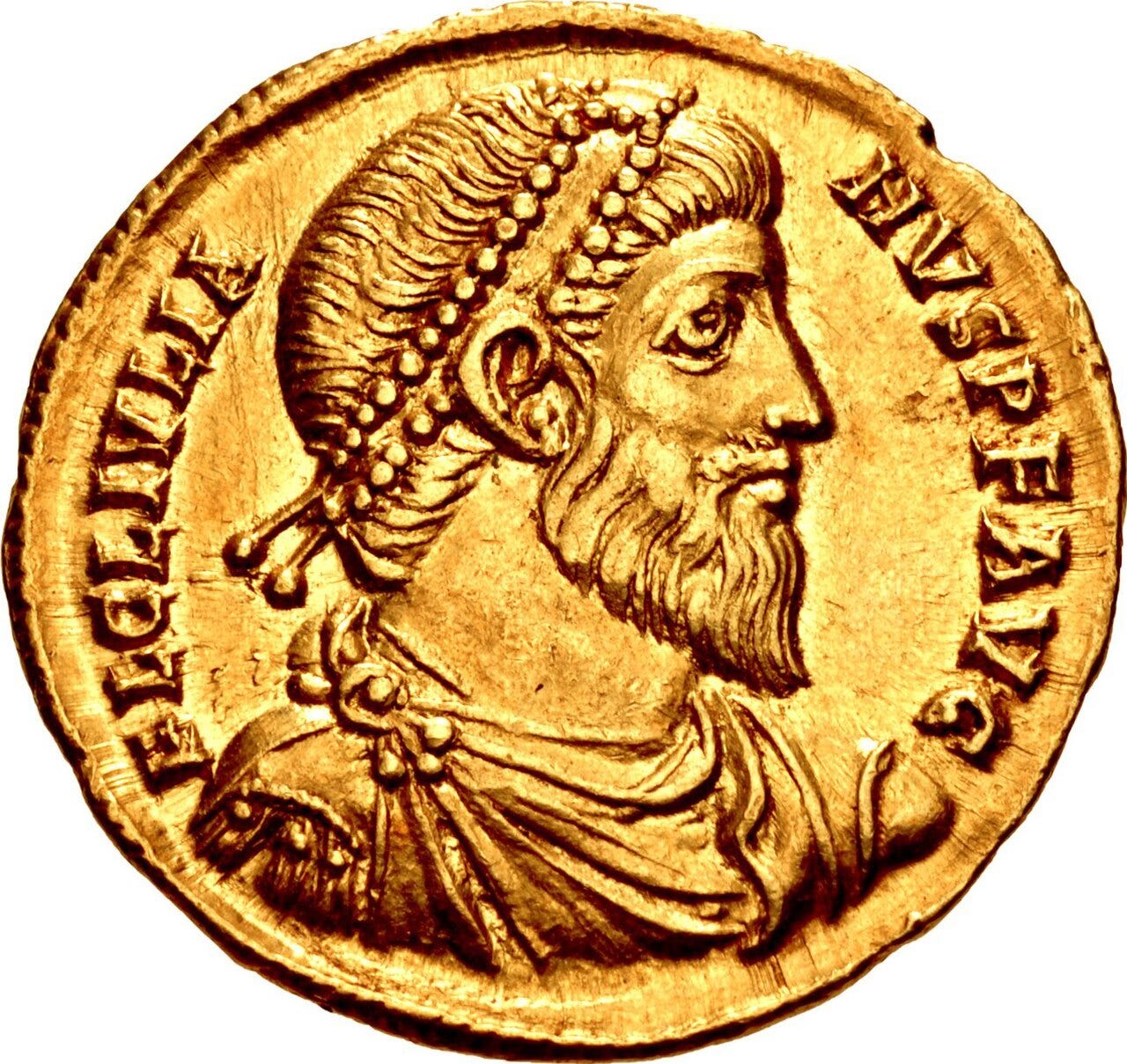
Julian (Source)

Back to Muehlberger
Muehlberger’s book is a collection of essays about how people in late antiquity knew, or thought they knew, about other people’s thoughts. How did they try to, or think they had, got inside other people’s heads? What she finds illustrates both similarities and differences with our society today. Differences are unsurprising, because that thinking is contained in their physical bodies, shaped by their experiences, not some abstract piece of philosophising on a scroll. She explains her approach thus:
Tim Whitmarsh and Jason König,in their volume Ordering Knowledge in the Roman
Empire, considered the effect of the empire’s power relations on fields like literature, medicine, and architecture. As they argued, the process of knowing “cannot be divorced from particular social relations and situations. It is not some abstract activity, practiced from a position of detachment; rather it is enacted within all institutions of social encounter.” This is a crucial insight. The kind of knowledge that informs fields as disparate as cosmology, or theories of the body, or standards of measurement all proceed from mechanisms that have their iterations at the level of the person. (p. 23)
The first essay is about a very standard, over centuries in the ancient world, practice of schooling for which we have a lot of evidence: boys around the age of 14 being given the classroom exercise of speaking like a woman, a sex worker or other transgressive woman, who has discovered wisdom (and so by definition given up the trade). There was all sorts of tricksy if not terribly complicated philosophical thinking going on here, but what Muehlberger is really interested in is what it did to the boys themselves. “Speaking as another person was an exercise in being powerful.”
“These imagined exercises created examples of impossible women, who then persisted in the imagination, parallel to reality. .. they came to stand in place of the kind of empirical knowledge one could gain by meeting, interacting with, and even living with, actual women … worked to install a disposition of arrogance and a confident self-generated knowledge that were unshakeable in the face of constant, iterated, real-world contact with those others…. he thinks he knows others better than they know themselves”. (p. 35)
You can sometimes in Waters account see that arrogance in his main characters, Drusus and Marcellus, and it is something that education of privileged young men - built of course to some extent on classical models - continues right up to the present day. I see it when I visit those schools and speak to the pupils.
The second essay is more directly about the shift to a Christian society, and the problem for what had been a persecuted minority when the majority apparently comes over to your side: how do you make sure people are sincere?
“Eusebius of Caesarea lamented fake Christians in explicitly architectural terms: there is an ‘unspeakable deceit’ committed by ‘those who slipped into the church and adopted the false facade of the Christian name.” (p. 81)
And Muehlberger sees that building metaphor as central — rather oddly to our understandings - to attempts by Christians to establish what was in others’ hearts.
“When Christians want to know about the Christianness of other whom they doubt, properties become an especially rich fund of information and eventually evidence to prove their deceit. Now, domestic houses in antiquity wer in fact the site of all kinds of religious activity, both traditional and Christian. And traditional piety tended to localize in the main, accessible rooms of a house. However, Kristina Sessa has documented a particular obsession for Christians: ‘the association of pagan rituals and objects with the cubiculum - that is, the innermost, privatest, room of the house…. Where many scholars have seen in this topos the prospect of evidence of actual pagan practices, I see the influence of the Christian way of prefiguring the unknown: proof of a person’s duplicity is hidden deep in their properties, behind the facade the public could see.” (p. 85-86)
And with that, she starts to paint a picture that makes Waters’ London of Christian thugs look all too accurate. (And makes me think about the brutal killing of the philosopher Hypatia.)
“As Shenoute observed, there is no crime in robbery ‘for those who have Jesus,’ just as in John of Ephesus’s Church History the crowd says they are not there to be robbers; instead they are Christian. In both retorts, the licence for violently executed scrutiny is tied to Christian identity. … Violence then can produce the proof it seeks, recasting the world according to the Christian knower: a seemingly Christian neighbor can be semi-Christian, insufficiently Christian, even falsely Christian”. (p. 88)
The final essay turns its gaze on us moderns, and how we look, literally at the world of late antiquity, with one of the most popular and often-displayed elements from it being the “Fayyum portraits” (there’s an extensive gallery of them in the Louvre). In this Muehlberger very usefully applies her critical method in a way that makes us just as fallible, our thought no more “scientific” or “modern”, than those schoolboys’, shaped by the world around us.
“The portaits as we encounter them are in fact modern European objects, created to answer modern European (and North American) desires and sensibilities. Although they go under the shorthand of ‘portraits’, and are at times claimed as evidence of ancient traditions of painting, they were produced within the parameters of photography, which primed 19th-century antiquities dealres to see value in faces and has influenced the reception of these objects ever since. A ‘Fayyum portrait’ then, is a kind of affective machine, which generates predictable responses from the viewers it was created to enthrall. (p. 139)
So what were the original objects? They were expensively prepared mummies of loved ones, “with the ‘face’ likely painted at the end of the long process of preservation - probably the piece of the assembled object most quickly created, and certainly the chepaest, as it was exected in egg, water, honey and wax on wood. When they were whole, … they were to preserve the whole bodies of the dead and, ultimately, to make them portable: these were piece taken and given in pawn, circulating to guarantee the financial commitments of those they had left among the living.”(p. 142)
Yes, the past was another country, with different values and ways of thinking. It changed, radically, many times. As can, and must, we.
Almost the end
Moving away from late antiquity, I have been reading Feathered Entanglements: Human Bird Relations in the Anthropocene. As its initial study, of Chinese cormorant fishing, notes:
“in recent years, anthropological studies have reconsidered the human-animal relationship to provide a new perspective on the traditional Euro-American dichotomy in which it is assumed that humans should control animals and keep them captive…. researchers have idenitified several important concepts such as joint commitment, hybrid community, multi-species ethnography, more-than-human society and post-domesticity… emphasizing the autonomy and agency of animals… deny that human-animal relationss fall into stark dichotomies in which humans are active and animals are passive”. (p. 30)
And it highlights how much knowledge, and wisdom, we are losing. To take just one of the case studies, of the Ibaloy people in the Philippines.
“Ibaloy knowledge about birds has eroded with time. Lolo Nardo states: “There are songs, but they are forgotten. Maybe if it had been taught in school, it could be sung right now. He underlined the good feelings that birdsongs inspired: “The birds, especially the ones living in the forest, are very good for us. They are good especially when they sing, and when you hear them while walking alone and sad, you will feel better.”… Lola Julie added…”These birds can help us, people, especially in clearing the bigis (a kind of pest) that destory our plants and crops. Other birds can also remove the lice of other animals such as the cow and carabao. …In the past, people always say that we must not burn the mountains so that the birds and other animals will not die. We must not hunt birds using our slingshot so that they will not all disappear or be gone.” (pp. 202-3)
What did you think?
You can also find me on Bluesky, Instagram, Facebook, LinkedIn, TikTok and X.