
Change Everything No 67: From more-than-human agents in climate fiction to nuclear disarmament
I wish you a probiotic Christmas and a new year in which outdated, dangerous ideas are demolished

Book news
Little reminder, for the politically-interested, or just politically curious giftee on your seasonal list, your local bookshop (in the UK at least) can probably still get a copy of Change Everything before Christmas Day.

Picks of the week
Reading - Fiction
Eva Meijer’s Sea Now would be an excellent addition to your festive pleasures list. Which seems an odd thing to say about climate fiction built around the entire nation of the Netherlands being swallowed up by the sea.
But it is often laugh-out-loud-if-bitterly funny: I loved the occasional appearance of the supermarket weekly special, tied to the increasing speed of disaster. And it is compassionate and engaging: the wide range of men, women and children, some of them politicians but mostly not, whose lives are transformed by the nation’s disappearance beneath the waves, not always in terrible ways, are wonderfully drawn and deeply human.
But what really makes this book stand out is its clear, captivating depiction of the more-than-human as agents, actors with varying levels of consciousness but real capacity to make choices about how they exist in the world. The sea is, of course, the largest character, but everything from pet cats to trees have cameo appearances as both individuals and species groups. Somehow I’m captivated by the idea of aquarium fish (aquariums being generally too large and fragile to transport when you flee for your life) suddenly finding themselves in an enormous sea. As Meijer practically notes, most of them being tropical have no hope, but for the hardier, what a transformation of their lives and understanding.
There’s a good extensive review here. (Also worth a listen is her New Books Network podcast about her non-fiction work Multispecies Assemblies, about how direct democracy could involve other species and natural entities. She’s a truly original thinker.)

An agent in its own existence. Photo by Greg Becker on Unsplash
Reading - Non-Fiction
Reading Beyond Britannia: Reshaping UK Foreign Policy, by (Lord) Simon McDonald, former head of the UK civil service, I found myself finding many points of agreement.
First, here’s someone prepared to acknowledge just how the climate emergency has failed to get the attention it so urgently demands:
“All my life, the health of the planet has been on the international agenda; for most of my career, it has been an item discussed when there is time, when everything else has already been discussed: important, but not most important.” (p. 139)
He’s even prepared to acknowledge “the greens are essential in calling out shortcomings and hypocrisy in government policy. On the green agenda, nationally and internationally, the British government talks the talk better than it walks the walk…. the importance of the planetary agenda demands that we do better, nationally and internationally.” (pp. 148-9)
But he’s yet to make the leap of understanding you can’t have infinite growth on a finite planet, complaining “The green parties in different parts of the UK seem otherworldly: Conservative and Labour politicians routine attack them for appearing to oppose any sort of economic growth.” (p. 148) Yep, that’s the reality: you can’t have infinite growth on a finite planet. Instead of thinking you can keep making the pie bigger, you have to slice it up more fairly.
He also puts UK nuclear disarmament front and centre of his proposals for the future: “My biggest idea is that the UK should put its nuclear deterrent on the negotiating table… Traditionally, British government have argued that their nuclear armament was so small compared with the US’s and USSR/Russia’s that it would come into consideration only when the two traditional superpowers had made savage cuts to their inventory. Logically, that is true… other things being equal, we can (and have) camped on our traditional arguments. Indeed, new Russian belligerence is an argument for maintaining the status quo. But other things are not equal. First, the nuclear deterrent is vastly expensive…Second, the British government has always made much of the fact that its nuclear deterrent is ‘independent’ But it is not. It is wholly dependent on the US. Nothing whose existence depends on someone else’s continuing goodwill can claim to be independent. Third, the UK will never use a nuclear weapon. Never. Period. British nuclear doctrine has always been framed in terms of a last resort when all other options are exhausted and when only a nuclear strike could save us…. The UK feels vaguely that possessing a nuclear deterrent is the price a country pays in order to remain a permnanent member of the UN Security Council…The P5 are the P5 because that is what the UN Charter stipulates… Ministers, especially Conservative ones, fetishise the nuclear deterrent: their argument appears to be that, although the UK no longer calls the shots, at least it still has nuclear weapons, because it belongs to the most exclusive of clubs and can never be pushed around. But the UK was pushed around - in the Falkland Islands, Iraq and Afghanistan - and the option of using nuclear weapons was never seriously considered…. My analysis - profoundly different from the UK government’s assessment - is that the UK’s opponents have concluded that there are no plausibly imaginable circumstances in which the UK might strike them with a nuclear weapon. That conclusion renders the nuclear deterrent functionally useless: an enormously expensive and ultimately pointless white elephant.” (pp. 216-219)
Which is quite closely aligned with the Green Party understanding, even if he’s definitively not for unliateral disarmament.
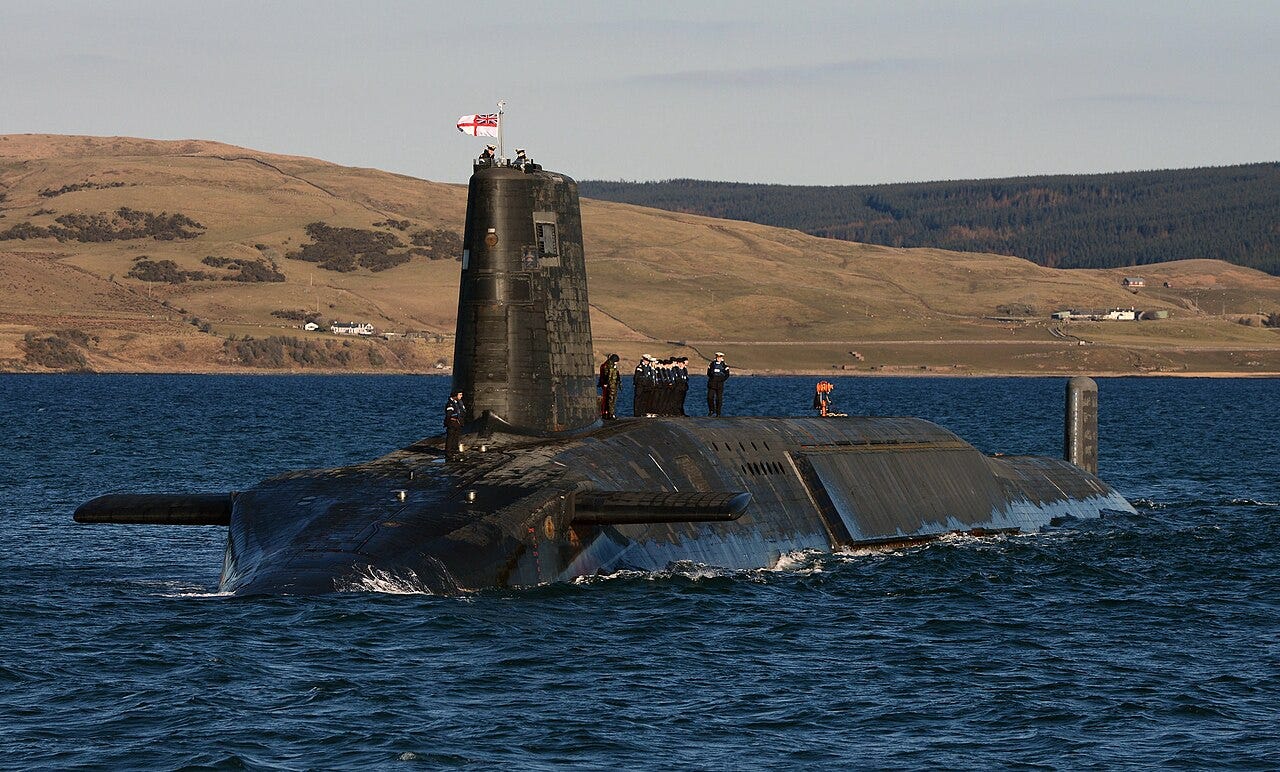
A British Vanguard-class submarine that can carry Trident nuclear weapons Source

Listening
On the New Books Network, an interview with Chandra Chiara Ehm, author of Queens Without a Kingdom Worth Ruling: Buddhist Nuns and the Process of Change in Tibetan Monastic Communities. As she says, a visitor might regard watching nuns debate theology as a timeless scene, and an unproblematic sign of female empowerment and agency.
But the opening - reluctant and contingent - of higher studies to women is very much related to the pressures of modernity and politics, the need for Tibetan communities to keep the high moral ground of human rights on the global stage. And a change in the nature of the students - as traditional families became wealthier and sought alternative opportunities for their daughters, the type of education they are seeking and even their level of Tibetan language skills. Not unchanging tradition, but very much modern life.
A short extract can be found here.

Photo by Raimond Klavins on Unsplash
Thinking
How do we take on rightwing nationalist thinking, challenge stereotypes and stories that are used to exclude those seen as “other” from national stories, that seek to restrict the diversity of societies today and contain the freedoms of members of them?
One thing I’m increasingly seeing is direct, evidence-based challenge to historical claims that provide a crucial foundation for this thought, from the artificial construction of “Western civilisation” (see Josephine Quinn’s brilliant work that I reported on in No 56) to the falsity of the idea of pristine nature that must be kept separate from the human.
Janina Ramirez begins Legenda: The Real Women Behind the Myths that Shaped Europe by quoting Eric Hobsbawn: “Historians are to nationalism what poppy growers … are to heroin addicts: we supply the essential raw material to the market”.
Ramirez adds: “Paying attention to how politicians, religious leaders and ideologues use the past - how they craft their rhetoric, so-opt history and install a feat of change - is, I feel, a present and urgent imperative. Should we not take a moment to look backwards and challenge the premise upon which our modern nations were built?” (p. 2)
The book is built on the little-remarked but clearly important fact that while nation creation is often gendered male - soldiers and statesmen, “explorers” and engineers - the symbols are often female.
“Inspiring people to feel bound together as one entity requires a unifying cause. What better cause than to make the nation a mother - a beloved motherland? The chivalric tradition lives on as men become inspired by these women of the nation, and bu the women of the past, to pursue their just cause. And so we find medieval women shackled to national histories throughout the 18th and 19th centuries”. (p. 5)
But other women are written out: Ramirez’s pairing of Joan of Arc and Charlotte Corday (assassin of Jean-Paul Marat during the French Revolution when she was aged 24) is particularly telling. Both were fervently religious women (“When Charlotte’s room was searched after the murder, investigators found her Bible open and underlined on the page was the description of Judith slaying Holofernes… On the scaffold of her execution, she declared to a priest: ‘The blood which I have split and my own, which I am about to shed, are the only sacrifices I can offer the eternal.’” (p. 25.) You might call it radicalisation in today’s terminology. Ramirez’s focus with Joan too is “about being a pious Christian who channelled God’s intention through their words and action” rather than the unlikely soldier of many modern depictions. (p. 34)
The famous painting of The Death of Marat by Jacques-Louis David (who is now the subject of a major exhibition at the Louvre, should you happen to be travelling this season, until January 26) entirely excludes Charlotte, erases her. And that’s largely been what’s happened to her place in French history, despite her sophisticated efforts, which Ramirez charts, to manage her public image, from the portrait that was painted of her, to the carrying of Plutarch’s Parallel Lives, which includes the story of the assassination of Caesar." “Charlotte felt that she was acting like Brutus. She had to put her knife into one man to help build a nation.” (p. 24)
Yet now, Joan is at the centre of rightwing nationalism. Ramirez begins the book, on May 1, 2017, with Jean-Marie Le Pen gives a speech under the first equestrian statue of Joan, “commissioned after France’s defeat in the Franco-Prussian War of 1870-1… to inspire revanchism, revenge against Germany”. (p. xi-xii) Le Pen begins: “Since its incpetion, the National Front has placed itself under the protection of Joan of Arc, the greatest person in history”.
There’s many more fascinating women in this book: the Eastern Roman princess and historican Anna Komene (who features in my next book), Marie of Oignies who created space for the Beguines and helped create the nation of Belgium, Empress Adelaide of Bavaria and Catherine of Sienna, each paired with an 18th-19th-century compatriot. For Britain? There’s Lady Godiva - in real life a powerful aristocratic women who could direct that taxes be reduced without needing to ride nake to achieve it, paired interestingly with Queen Victoria.
I can’t do the book full justice here: recommended reading.
Researching
Less than 1% of global health research funding is spent on traditional medicines, which reflect the accumulated knowledge of millennia of experience. But the World Health Organisation Second Summit on Traditional Medicine that has just finished in New Delhi aimed to “chart a global roadmap for integrating safe, evidence-based traditional medicine into health systems”. The Telegraph (£) reported on one study in Papua New Guinea of a promising traditional treatment:
Dr. Prescott and his coworkers discovered that, at higher concentrations, the [New Guinea Rosewood tree] sap has antibacterial effects but at much lower concentrations it stimulates keratinocytes, the top layer of skin cells, and this might encourage wound healing.
Encouragingly, with the summit came the launch of a new Traditional Medicine Global Library. With so much knowledge at risk of being lost forever, that’s important. But even more important is acknowledging that profit-driven medical research is bad for the health all of us: we won’t get to healthier lives by focusing on research that aims to make windfall profits from drugs to deal with largely avoidable illnesses, medicines that won’t be available to many, whether the uninsured mother in America or the child in PNG.
Almost the end


You probably knew tardigrades are fascinating creatures, some 1,800 species so distinct they have their own phyla, and some so successful that some species are “cosmopolitan”: found more or less everywhere on this planet. They’ve been around for about half a billion years. Although their capacity to emerge intact from apocalyptic conditions means they are misunderstood: survive (which they do by cryptobiosis (essentially extreme hibernation or shut-down almost to death) doesn’t mean thrive; they’re actually quite fussy about habitats, which means — like so much other life on this planet — the damage we’re doing certainly will impact them.
All of this is from a lovely long read in Prospect magazine. And bringing us back to where we started, the researchers interviewed for it have clearly come to see tardigrades as agents in their own lives, individuals, some intrepid, some timid, but also living in community: if one is injured, it somehow (no one really knows how) communicates the injury to others who will try to flee. To escape predators they’ll sometimes climb onto the backs of the beast where it cannot reach them.
It is an encouraging thought to enter the festive season with: more and more humans are starting to grasp that we are just one species on this astonishingly rich and creative planet on which life has developed for over four billion years, each shaping its own existence as it has cooperated with others.
On that hopeful note I can only finish by wishing you a probiotic (after geographer Jamie Lorimer) Christmas.

Photo by Sebastian Unrau on Unsplash
What did you think?
You can also find me on Bluesky, Instagram, Facebook, LinkedIn, TikTok and X.
I'm grateful for putting me onto "Beyond Britannia" which I've been able to download